




 Date:
19 nov., 2026
 Classic Motorcycles
 Publié par
Super Admin
A modern motorcycle with the soul of a racing legend
Some motorcycles are designed simply to transport their riders from one place to another. Others are created to evoke memories, emotions and an entire era of motorcycling history.
The Yamaha XSR900 GP undoubtedly belongs to the second category.
With its unmistakable Grand Prix-inspired styling, powerful three-cylinder engine and carefully developed modern technology, the XSR900 GP represents a fascinating meeting point between Yamaha's legendary racing heritage and contemporary motorcycle engineering.
Inspired by the golden era of Grand Prix racing during the 1980s and early 1990s, this motorcycle brings back the visual identity of some of the most recognisable racing machines ever produced by Yamaha.
But there is more to the XSR900 GP than nostalgic styling. Beneath its retro-inspired bodywork lies a thoroughly modern sporting motorcycle, combining performance, sophisticated electronics and a chassis designed for enthusiastic riding.
The result is one of the most interesting modern Sport Heritage motorcycles on the market.
For collectors, Yamaha enthusiasts and riders who appreciate motorcycles with a genuine connection to racing history, the XSR900 GP deserves particular attention.
And thanks to Yamaha's Yard Built programme, the model has also become an exceptional platform for recreating some of the most iconic racing liveries of the past.
The golden age of Yamaha Grand Prix racing
To understand the appeal of the XSR900 GP, it is worth looking back at the period that inspired its design.
During the 1980s and early 1990s, Grand Prix motorcycle racing was entering an extraordinary period. The 500cc two-stroke machines were becoming increasingly sophisticated, manufacturers were investing heavily in racing technology, and riders were developing almost legendary reputations.
Yamaha played a central role in this era.
Its competition motorcycles became instantly recognisable thanks to their distinctive colours, aggressive fairings and unmistakable racing identity.
The Yamaha YZR500, in particular, became one of the defining machines of the period.
For an entire generation of enthusiasts, these motorcycles represented the ultimate expression of speed, technology and competition.
The riders who raced them became household names among motorcycle fans.
Names such as Wayne Rainey, Eddie Lawson, Kenny Roberts, Randy Mamola and Joan Garriga remain closely associated with this remarkable period.
Their motorcycles were not simply racing machines. They became cultural icons.
It is precisely this atmosphere that Yamaha wanted to recreate with the XSR900 GP.
Rather than producing a conventional modern sportbike, Yamaha developed a motorcycle that visually celebrates its racing heritage while retaining the engineering standards expected of a contemporary machine.
Yamaha XSR900 GP: design inspired by racing history
The first thing that attracts attention is the bodywork.
The upper fairing, compact windscreen, racing-inspired cockpit and sculpted rear section immediately recall the Grand Prix motorcycles of the 1980s.
The proportions are particularly important.
Unlike many modern retro motorcycles, which concentrate primarily on round headlights and classic roadster styling, the XSR900 GP takes its inspiration directly from competition machinery.
Its front fairing gives the motorcycle a distinctive racing silhouette, while the riding position and overall proportions reinforce its sporting character.
The attention to detail is what makes the design particularly successful.
The fairing is not simply decorative. Its shape also contributes to aerodynamic performance, while the riding position creates a more purposeful connection between rider and machine.
Yamaha has managed to create something that feels genuinely inspired by its racing past rather than simply decorated to look old-fashioned.
A tribute to the Yamaha YZR500
The original XSR900 GP design draws inspiration from several generations of Yamaha racing motorcycles.
The colours and graphics associated with the YZR500 are especially important.
These machines established a visual language that remains instantly recognisable to enthusiasts today.
The XSR900 GP takes those historic references and translates them into a contemporary motorcycle without sacrificing its modern identity.
This combination is one of the strongest reasons why the model has attracted so much attention.
It appeals not only to younger riders discovering Yamaha's racing history, but also to enthusiasts who remember watching these legendary machines competing on television and at the circuits.
Yard Built Back to the Paddock: bringing racing legends back to life
One of the most fascinating developments surrounding the XSR900 GP came from Yamaha's Yard Built programme.
Under the name "Back to the Paddock", Yamaha explored the idea of celebrating legendary racing motorcycles and riders from different European countries.
The concept was straightforward but extremely effective.
Start with the modern XSR900 GP and transform its appearance into a tribute to an iconic racing machine or a legendary rider.
The result was a series of visually striking custom motorcycles that demonstrated just how well the XSR900 GP lends itself to historic racing liveries.
Two particularly interesting interpretations were presented around the Wheels & Waves event in Biarritz, France, in June 2024.
They paid tribute to two very different but equally memorable figures from Grand Prix history: Joan Garriga and Randy Mamola.
These projects demonstrated that the XSR900 GP is much more than a retro-inspired production motorcycle. It is also a canvas for celebrating Yamaha's extraordinary sporting heritage.
Joan Garriga: the Spanish racing legend behind the Ducados tribute
For Spanish motorcycle enthusiasts, the name Joan Garriga carries a very special meaning.
Known affectionately as "El Comecocos", Garriga became one of the most recognisable Spanish motorcycle racers of his generation.
His aggressive riding style, competitive personality and distinctive racing machines made him a favourite among fans during the 1980s and early 1990s.
His Yamaha racing colours became particularly memorable.
The combination of blue, white and gold created a visual identity that remains instantly recognisable to enthusiasts who remember that period.
It was an era when racing motorcycles had strong individual identities, and the colours of a particular rider could become almost as famous as the rider himself.
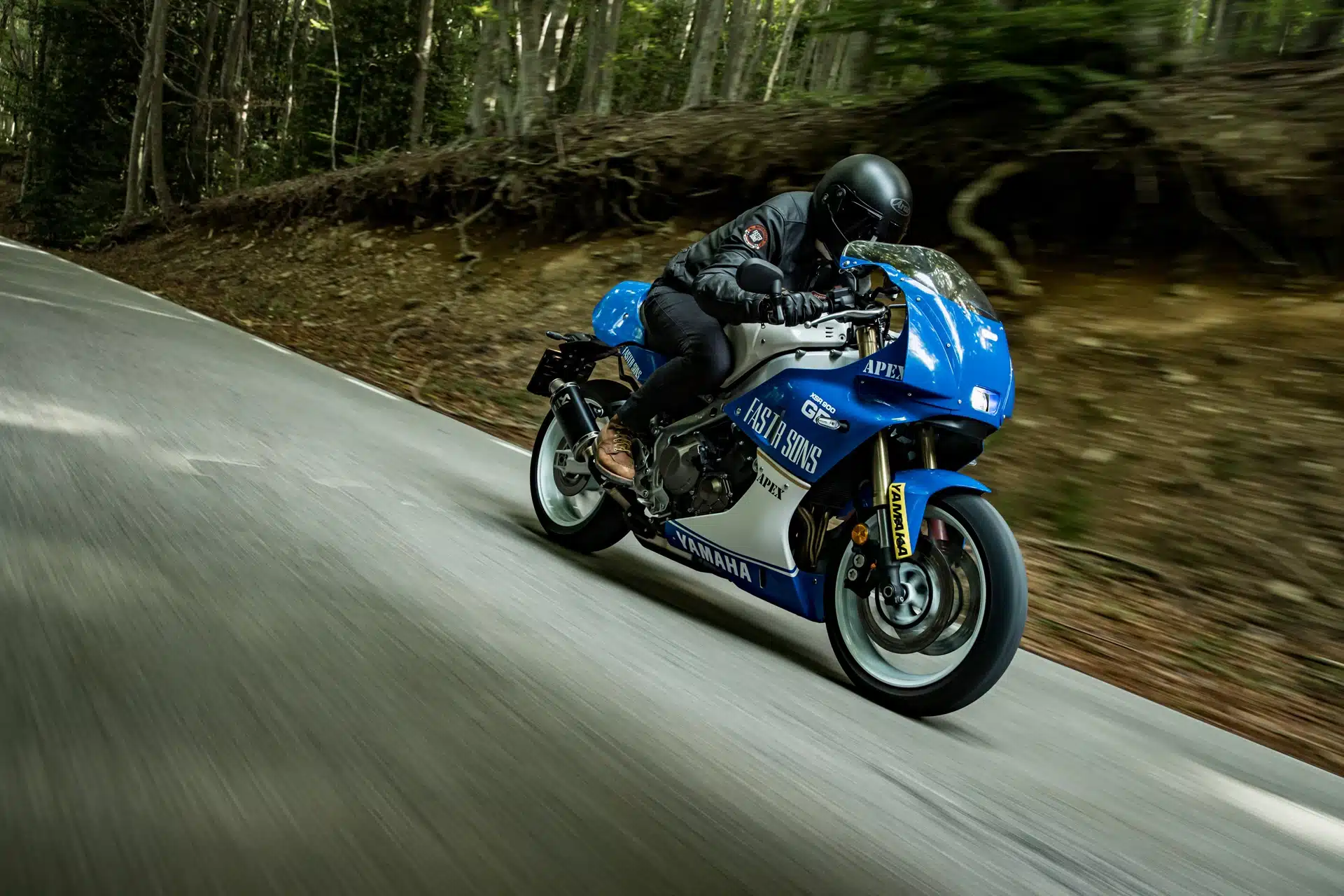
The Yamaha XSR900 GP Joan Garriga replica
As part of the Back to the Paddock project, Yamaha presented a particularly emotional interpretation of the XSR900 GP.
Created in collaboration with APEX Autocenter, a specialist in vehicle graphics and vinyl work, the motorcycle received a livery inspired by Joan Garriga's iconic Yamaha racing machines.
The blue, white and gold colours transform the modern XSR900 GP into a contemporary tribute to one of Spain's most memorable racing heroes.
The result is striking.
The original racing identity works remarkably well with the XSR900 GP's bodywork, demonstrating how naturally the modern motorcycle lends itself to historic competition-inspired designs.
For enthusiasts who grew up watching Garriga race, the visual connection is particularly powerful.
It is also interesting to remember that Garriga's famous Yamaha colours influenced more than just racing fans.
The styling became associated with road-going Yamaha sports motorcycles as well, including the legendary TZR80, a model that became an aspiration for many young riders.
The Yard Built interpretation therefore connects several generations of Yamaha enthusiasts through a single design.
It is important to note that this Joan Garriga tribute was a special Yard Built project rather than an officially announced mass-production edition.
That distinction makes it especially interesting from a design and motorcycle culture perspective.
Randy Mamola and the unmistakable Lucky Strike colours
The second major Back to the Paddock interpretation celebrated another Grand Prix icon: Randy Mamola.
Mamola was one of the most charismatic riders of the 1980s.
Known for his spectacular riding style and entertaining personality, he became one of the most recognisable figures in the 500cc Grand Prix championship.
His Yamaha YZR500 from the 1987 season, wearing the famous Lucky Strike-inspired racing colours, remains an important reference for motorcycle enthusiasts.
The XSR900 GP tribute recreated that visual identity in a modern setting.
The project was developed through Yamaha Motor Europe, with the paintwork undertaken by Robert Lammers and the graphics by Eddy Speelman.
The Lucky Strike-inspired decoration gives the XSR900 GP an entirely different personality compared with the Joan Garriga interpretation.
Where the Garriga tribute celebrates Spanish racing heritage through blue, white and gold, the Mamola version brings back the distinctive visual character of American-influenced Grand Prix racing.
Together, these motorcycles demonstrate the extraordinary versatility of the XSR900 GP's design.
They also highlight something important: historic racing liveries continue to have a powerful emotional connection with motorcycle enthusiasts decades after the original machines disappeared from competition.
The engineering underneath the retro styling
While the appearance is clearly inspired by the past, the engineering of the XSR900 GP is thoroughly modern.
At the heart of the motorcycle is Yamaha's well-known CP3 three-cylinder engine.
This liquid-cooled, 890cc engine features double overhead camshafts and four valves per cylinder.
Its specifications are impressive:
Engine configuration: liquid-cooled, inline three-cylinder
Displacement: 890cc
Maximum power: 119 PS at 10,000 rpm
Maximum torque: 93 Nm at 7,000 rpm
Transmission: six-speed gearbox
Final drive: chain
Fuel injection: electronic
The engine delivers a combination of strong mid-range torque and an exciting upper-revving character.
This is one of the defining characteristics of Yamaha's CP3 platform.
Unlike some traditional four-cylinder sportbikes, the three-cylinder configuration offers a particularly engaging balance between responsiveness, flexibility and performance.
The engine is also an important part of the motorcycle's personality.
Its sound and power delivery contribute to the overall riding experience, creating a machine that feels genuinely sporting without becoming unnecessarily difficult to enjoy on the road.
A modern chassis with sporting ambitions
The XSR900 GP uses a lightweight aluminium Deltabox frame.
This frame technology has a long history within Yamaha's sporting motorcycles and provides the structural foundation for the machine.
Suspension is provided by KYB components, with adjustable settings designed to allow riders to tailor the motorcycle to their preferences.
The braking system uses twin front discs measuring 298mm, supported by a rear disc measuring 245mm.
The overall package is designed to offer confidence during spirited road riding while retaining the visual character of a classic Grand Prix motorcycle.
The technical specifications also underline how far motorcycle engineering has progressed since the original racing machines that inspired the design.
Modern technology meets an analogue racing atmosphere
One of the most impressive aspects of the XSR900 GP is the way Yamaha has integrated contemporary electronics without compromising the motorcycle's nostalgic appearance.
The cockpit combines retro-inspired styling with a modern five-inch TFT colour display.
The motorcycle also benefits from an advanced electronic package.
Depending on the model specification and market, the equipment includes:
Six-axis inertial measurement unit (IMU)
Lean-sensitive traction control
Slide control system
Lift control
Multiple riding modes
Quick Shift System
Assist and Slipper clutch
Cruise control
Adjustable suspension
These systems help make the XSR900 GP a much more sophisticated motorcycle than its historic appearance might suggest.
The combination of a modern IMU and rider assistance systems is particularly interesting.
While the original Grand Prix machines relied heavily on rider skill and mechanical feedback, the modern XSR900 GP benefits from technology developed through decades of motorcycle engineering progress.
It is an excellent example of how heritage and innovation can work together.
Why the Yamaha XSR900 GP is attracting collector attention
The modern classic motorcycle market has evolved considerably over recent years.
Collectors are no longer interested exclusively in motorcycles produced several decades ago.
Certain contemporary models are increasingly appreciated because of their historical connections, distinctive design and limited or unusual specifications.
The Yamaha XSR900 GP has several characteristics that make it particularly interesting in this context.
1. A direct connection with Yamaha racing history
The motorcycle does not rely on a generic retro appearance.
Its styling references identifiable Grand Prix machines and a specific period of Yamaha competition history.
For enthusiasts who appreciate the brand's racing heritage, this connection adds genuine appeal.
2. A distinctive design
The full upper fairing, compact proportions and racing-inspired details make the XSR900 GP stand out from the large number of modern naked and retro motorcycles.
Its design is immediately recognisable.
3. A highly regarded engine platform
The CP3 three-cylinder engine provides strong performance and an engaging riding character.
It also gives the motorcycle a level of mechanical sophistication that makes it suitable for regular use rather than simply being an attractive garage ornament.
4. Personalisation possibilities
The Yard Built Back to the Paddock project demonstrated the potential of the XSR900 GP as a base for historically inspired customisation.
Joan Garriga and Randy Mamola are two particularly memorable examples, but the motorcycle's design opens the door to many other interpretations.
5. A combination of old and new
Perhaps the most important characteristic is the combination of classic racing inspiration and modern engineering.
This makes the XSR900 GP interesting to several different types of buyers: traditional Yamaha enthusiasts, modern sportbike riders and collectors who appreciate contemporary motorcycles with a strong historical identity.
However, it is important to distinguish between the standard production motorcycle and special Yard Built creations.
A particular colour scheme or custom build should not automatically be considered a factory limited edition. Its provenance, originality and documentation should always be checked individually.
What should buyers look for when considering a Yamaha XSR900 GP?
For anyone considering purchasing an XSR900 GP, the model deserves the same careful attention as any other modern performance motorcycle.
A detailed inspection should include:
Service history
Check whether scheduled maintenance has been carried out and whether supporting invoices or service records are available.
Overall condition
Inspect the bodywork, fairing, paintwork, wheels, suspension and braking components for damage or signs of previous repairs.
Originality
Determine whether the motorcycle retains its original factory specification or has been modified.
This is particularly important for motorcycles carrying special racing-inspired graphics.
Mileage and usage
Mileage should be considered together with the motorcycle's general condition and maintenance history.
A well-maintained motorcycle with higher mileage may be a more attractive purchase than an example with very low mileage but incomplete documentation.
Electronic equipment
Check the TFT display, riding modes, rider assistance systems and other electronic features.
Documentation
Confirm the registration documents, ownership history, VIN and any documentation relating to special paintwork or customisation.
For a motorcycle with a particularly interesting racing-inspired specification, photographs and invoices documenting the work can add valuable context.
Yamaha XSR900 GP: a modern classic with a racing identity
The Yamaha XSR900 GP is an excellent example of how a manufacturer can look back at its history without becoming trapped by nostalgia.
Its design recalls an extraordinary period in Grand Prix racing, while its engine, chassis and electronics place it firmly within the modern motorcycle world.
The Back to the Paddock project took this idea even further.
By celebrating riders such as Joan Garriga and Randy Mamola, Yamaha demonstrated how powerful the connection between motorcycle design and racing history can be.
For enthusiasts who remember the original YZR500 machines, the blue, white and gold Garriga tribute or the unmistakable Lucky Strike-inspired Mamola interpretation can bring back memories of an unforgettable period.
For younger riders, the XSR900 GP offers the opportunity to experience that racing aesthetic with contemporary performance and technology.
It is not simply a motorcycle that looks backwards.
It is a motorcycle that successfully brings the spirit of an earlier era into the present.
Discover the Yamaha XSR900 GP on Epic Motor Trading
For enthusiasts looking to own a motorcycle that combines Yamaha racing heritage, distinctive styling and modern engineering, the XSR900 GP is certainly worth considering.
At Epic Motor Trading, we connect motorcycle enthusiasts, collectors and professional sellers through a dedicated marketplace for interesting motorcycles and exceptional vehicles.
Interested in this Yamaha XSR900 GP?
Take a closer look at the motorcycle currently advertised on Epic Motor Trading.
Discover the photographs, specifications, condition, seller information and full advertisement details before making your next move.
VIEW THE YAMAHA XSR900 GP FOR SALE ON EPIC MOTOR TRADING
Whether you are looking for your next riding motorcycle or adding an interesting modern classic to your collection, the right opportunity could be closer than you think.
Epic Motor Trading – Connecting exceptional motorcycles with the people who appreciate them.


Comment (00)